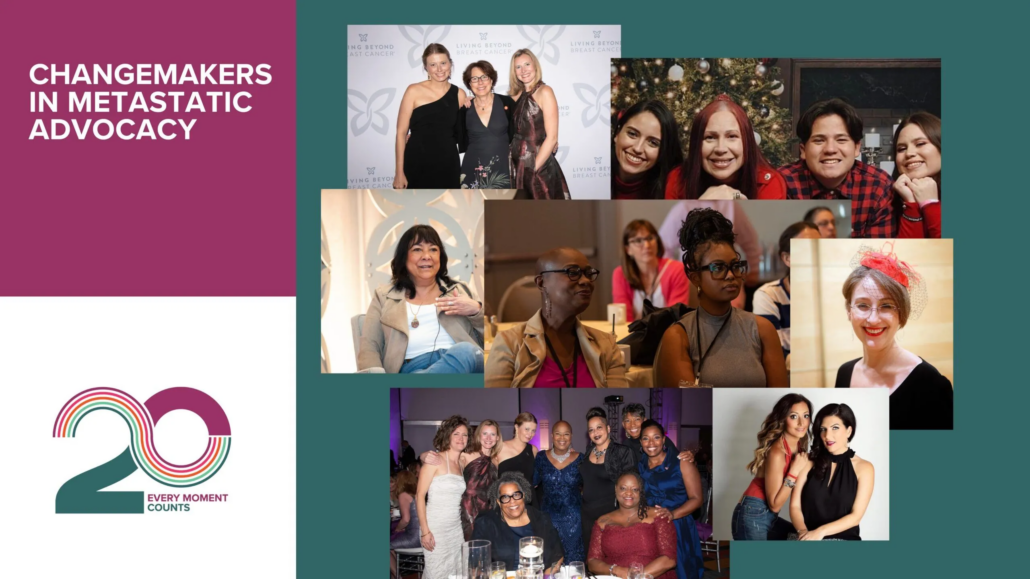
Changemakers in metastatic advocacy
With metastatic breast cancer, every moment counts. Celebrating 20 years of people, progress, and connection at the Conference on Metastatic Breast Cancer
By Wendy Univer, Adrienne Cornwall, Jean Sachs, MSS, MLSP | Medical Review: LBBC Staff
Twenty years ago, metastatic breast cancer (MBC) was not something people talked about. Stage IV was referred to as “advanced breast cancer” and represented a fearful, lonely place.
While other groups focused predominantly on early-stage breast cancer, Living Beyond Breast Cancer leaned into difficult conversations. That early work laid the foundation for our Conference on Metastatic Breast Cancer, now the longest consecutively running and most well-attended of its kind in the U.S., with more than 10,000 attendees over two decades. People with MBC have found connection, information, and support in this space for 20 years.
To celebrate the 20th anniversary of Living Beyond Breast Cancer’s Conference on Metastatic Breast Cancer, we want to recognize a few of the highlights, shared history, and remarkable changemakers that have had an outsized impact on the metastatic community. We hope these stories inspire you to make every moment count.

A watershed moment for MBC awareness
Following LBBC’s founding in 1991, we sensed that urgent needs among the metastatic community weren’t being met. In 2005, we conducted the first survey to understand people living with MBC and received nearly 700 responses. Elyse Spatz Caplan, director of educational programs and partnerships at the time, says: “It was clear from our survey that people with metastatic disease felt alienated, isolated, and alone.” Janine Guglielmino, former vice president for mission delivery, remembers, “They had a deep desire to connect with one another in person, to share stories and talk about really hard things.”
LBBC Chief Executive Officer Jean Sachs adds that there was a “desperate need for reliable medical information.” LBBC published the survey results, a white paper known as Silent Voices, for the entire breast cancer community and presented them at the San Antonio Breast Cancer Symposium (SABCS) in 2006. “We had all this data that no one else had. We felt obligated to share it” with anyone who could contribute solutions, says Elyse.
A conference built around people’s needs
In 2007, LBBC stepped up to the challenge and held the first in-person conference on metastatic disease with about 100 participants. Attendees ranged from those in wheelchairs with oxygen to the newly diagnosed. Jean notes, “We had to build a pace that worked for people’s lives — starting later in morning, providing more breaks and extra hydration.” Elyse emphasizes that LBBC did not want cost to be a barrier to attendance, so fundraising for travel grants began with the very first conference. Partners and caregivers were always welcome, and specific breakouts for them were added in 2009.
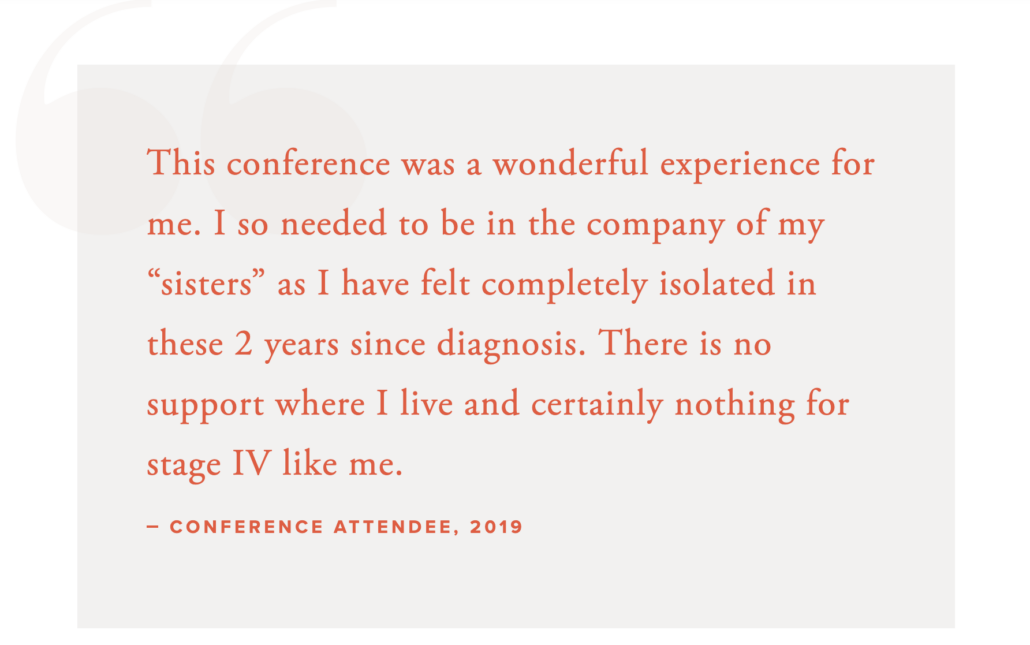
“The positive response was overwhelming,” says Janine, “and the emotion in the room was palpable.” Post-conference surveys included comments such as: “I feel more empowered to beat this disease and to have a long life.” “I am not alone.” “A life-changing conference.”
Elyse says early surveys also showed widespread interest in palliative care information, but no place to find it. LBBC added this to future agendas and created a brochure on the subject. Feedback also highlighted attendees’ desire to participate in conference planning. Therefore, in 2019 the Patient Advisory Committee was added to the planning process for the 2020 conference.
Growing community alongside treatment expansion
Jean explains that “around the time of our early metastatic conferences, trastuzumab (Herceptin) was approved by the FDA, which changed everything for people with HER2-positive tumors.” Many other advances followed. Researchers developed increasingly effective tools like biomarker testing to identify specific breast cancer types, allowing for targeted therapy and other more personalized treatments. The community saw the advent of new hormonal therapies, CDK4/6 inhibitors, immunotherapies, antibody drug conjugates, and more, leading to more lines of treatment, longer disease stability, and extended survival for many people with MBC.
As knowledge about breast cancer subtypes grew and treatment algorithms became vastly more complex, LBBC balanced presentations of new clinical information with the supportive information attendees needed. Topics such as self-care, helping children understand cancer, participation in clinical trials, and tools for talking to partners were added. Experiential sessions such as yoga, sound baths, and even a joyous dance party entered the agenda.

Connecting passionate participants with generous experts
Leaders in breast cancer research from prestigious institutions came to speak at early conferences without any honorarium fees. They often stayed to answer questions from long lines of participants who were having their very first opportunity to speak with a specialist in the field. Both Jean and Elyse recall how Julie Gralow, MD — currently chief medical officer and executive vice president of the American Society of Clinical Oncology (ASCO) and founder of the Women’s Empowerment Cancer Advocacy Network — took the red-eye flight from a family vacation near Seattle, showered quickly at the hotel, gave her talk, and flew back. Olufunmilayo I. Olopade, MD, director of the Center for Clinical Cancer Genetics and Global Health at University of Chicago Medicine, flew to Philadelphia directly from work in Africa.
People with MBC also had a fervent commitment to learning and sharing their knowledge. To leverage this passion and expand its impact even farther, LBBC launched Hear My Voice (HMV) metastatic advocacy leadership training in 2015. Thirty-one people from 18 states spent the day before the conference learning about metastatic disease and how to share their personal stories, as well as the larger story of MBC. Since then, hundreds of HMV advocates have reached millions of people across the nation, with a special emphasis on reaching out to people who were traditionally ignored.
Many people recall the year that longtime HMV volunteer Sarita Joy Jordan — who blogged about her experience as a Black woman with metastatic hormone-positive breast cancer — wanted to join the “Learning From Each Other” panel at the end of the conference. Sarita came directly from the hospital with her son, and LBBC provided a motorized wheelchair. She sat on the panel and answered questions, knowing it was one of the last things she would do in her life.
An incubator for new advocates and organizations
Today, the vibrant, varied community of stage IV advocacy includes numerous champions and organizations that trace their origins back to LBBC’s metastatic conference and HMV training. Jean says: “I’m so proud of the way these people took up the charge and expanded our reach, especially efforts to include everyone, regardless of race, age, ethnicity, gender, gender identity, income, or geography.”
New advocates have taken on issues such as the continuing need for diverse participation in clinical trials, patient-centered dosing, and FDA approval of more than one starting dose for medications. Twenty years ago, very few patient advocates attended SABCS, the world’s largest scientific gathering on breast cancer. In 2026, not only were over 500 patient advocates present, but advocate perspectives were included in every panel.
Catherine Ormerod, former LBBC executive vice president for strategy and mission, emphasizes the role of social media in magnifying the influence of MBC advocates across the nation. Facebook and Twitter were new platforms taking off with the public around the first LBBC metastatic conference. Ardent attendees and HMV alums launched blogs; Facebook pages; Twitter streams; and later, podcasts.
“The isolation of individuals living with MBC was beginning to break down, thanks to the internet’s ability to virtually connect individuals and organizations,” says Catherine. “By 2013, the voices of people living with MBC were silent no more. They communicated their feelings, thoughts, demands and criticisms of available services, research funding levels, and more, via social media.” This not only contributed to improving individual quality of life, “it also informed and enriched the nonprofit services and research communities that served people living with metastatic disease.”

Unwavering commitment to make every moment count
While the landscape of diagnosis and treatment has changed vastly and continues to evolve, Janine asserts that “LBBC’s commitment never wavers.” When the COVID-19 pandemic forced the last-minute shutdown of the March 2020 conference, LBBC quickly reconfigured the entire event and held it online. Jean points out that the first budget for travel vouchers in 2007 was $5,000; this year it is over $80,000. Nearly 400 people will attend in person, with hundreds more participating via livestream.
The 20th anniversary theme, Every moment counts, honors both the sense of urgency and the gratitude experienced by attendees and staff. As Janine puts it, “It’s not how long you live, but what you can do to find meaning in the time that you have. Living Beyond Breast Cancer has been able to unlock meaning for thousands of people with metastatic breast cancer who might have not been able to find meaning before.”
In the words of HMV advocate Janice Cowden, recognized this year as a Changemaker honoree for her contributions to MBC advocacy, “The connections I’ve made through Living Beyond Breast Cancer and the broader MBC community — especially the close friendships with other patients and advocates — are truly among the greatest gifts I’ve received since my metastatic triple-negative diagnosis. I treasure those relationships deeply. They fuel my passion to stay connected and to keep doing this work, not only for those I’m still fortunate to walk alongside, but also in honor of the dear friends we’ve lost along the way. In the beginning, I did this for myself. Now, having been fortunate to live longer than anyone expected, I do it for them.”